-
-
Metal One’s businesses and roles
-
Plate, Construction & Tubular Products Business Division
-
Flat Products Business Division
-
Global Business Division
-
Global Marketing & Energy Project Business Division
-
Wire, Specialty & Stainless Steel Business Division
-
Digital transformation
-
Carbon neutrality
-
Business creation and innovation
-
-
Recruiting information
-
Terms of Use
Myohoji Temple’s Iron Gate

Myohoji Temple’s Iron Gate
Suginami
Gate Designed by Josiah Conder Blends Japanese and Western Styles

Myohoji Temple is located in Suginami City’s Horinouchi district in Tokyo. It is a Nichiren sect temple that was built around 1618. Since the Edo Period (1603–1867) Myohoji has been recognized among the townspeople as the temple enshrining the sect’s founder, who reportedly had the power to ward off evil. Even now this temple has numerous worshippers visiting from all around the country.
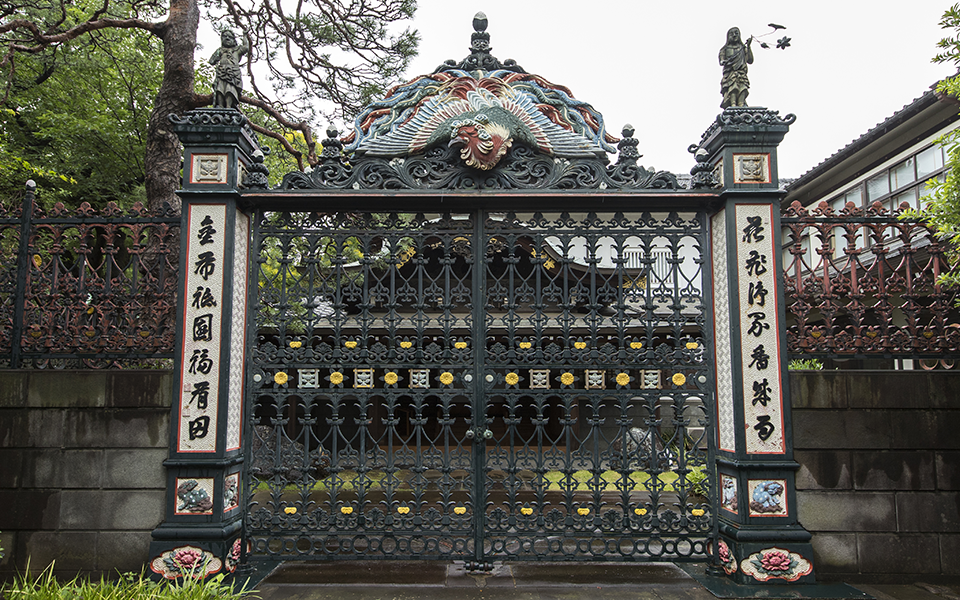
An old iron gate located within Myohoji Temple’s precincts was built in 1878, the eleventh year of the Meiji Period (1868–1912). The gate has a traditional Western acanthus pattern design, topped with a phoenix—a mythical bird considered auspicious in Japan since ancient times—and presents a vivid blend of Japanese and Western styles. This cast-iron gate was quite valuable in an era when Japan still had not achieved modern iron production. Together with its novel design, it was something many people came specifically to see.
The gate’s designer was architect Josiah Conder, an Englishman involved with the Rokumeikan and many other famous buildings, and was known as the “father of modern architecture in Japan.”
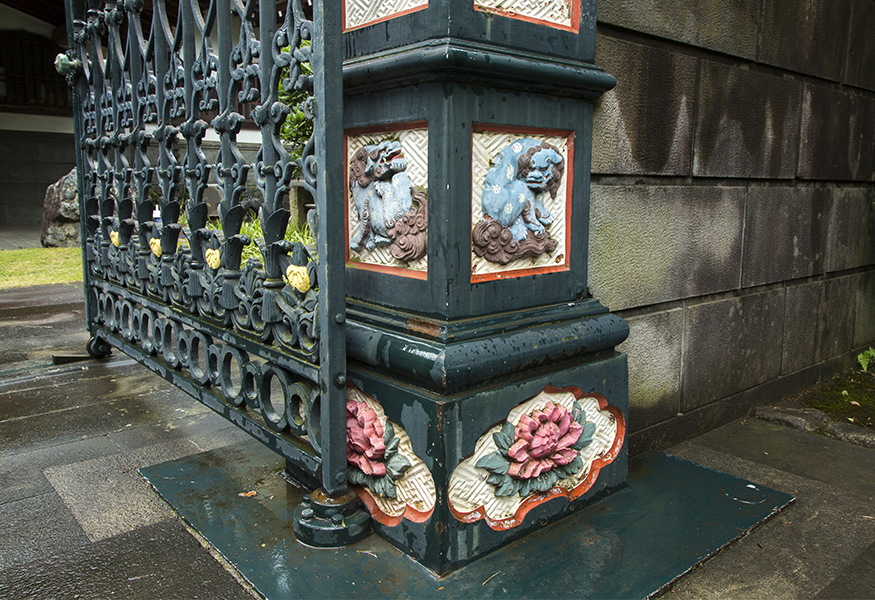
Conder came to Japan in 1877 as what was referred to as a “government-hired foreigner,” invited by the Meiji government to secure the advanced Western technology and expertise that Japan needed to modernize. Taking up a post as a teacher at the Imperial College of Engineering (today’s University of Tokyo, in the Faculty of Engineering’s Department of Architecture), he had a hand in designing over a hundred structures during his lifetime. Those structures ranged from the Rokumeikan, the Holy Resurrection Cathedral in Tokyo, the Mitsubishi Ichigokan Building (restored to become the Mitsubishi Ichigokan Museum in 2009), the former Iwasaki Residence, the former Shimazu Residence (site of today’s Seisen University), and the former Furukawa Garden.
Conder also trained Kingo Tatsuno—whose designs included Tokyo Station and the Bank of Japan’s main branch—and many other Japanese architects, laying the foundations for Japanese architecture from the Meiji Period onward.
Conder designed Myohoji Temple’s iron gate the year after he arrived in Japan. Full of the spirit of enterprise, Myohoji Temple got on board with the trend toward cultural enlightenment, asking the Ministry of Public Works for a cast-iron gate, something nearly unprecedented among Japanese temples. The design is believed to have been left up to Conder, who had a profound knowledge of Japanese art and architecture from the outset.
Myohoji Temple’s iron gate was recognized as a nationally designated Important Cultural Property in 1973 in recognition of its historical value. This work of art is also something of a memorial to Conder, who spent his life in Japan and had an abiding love of Japanese culture.
Value One 2020 No. 69