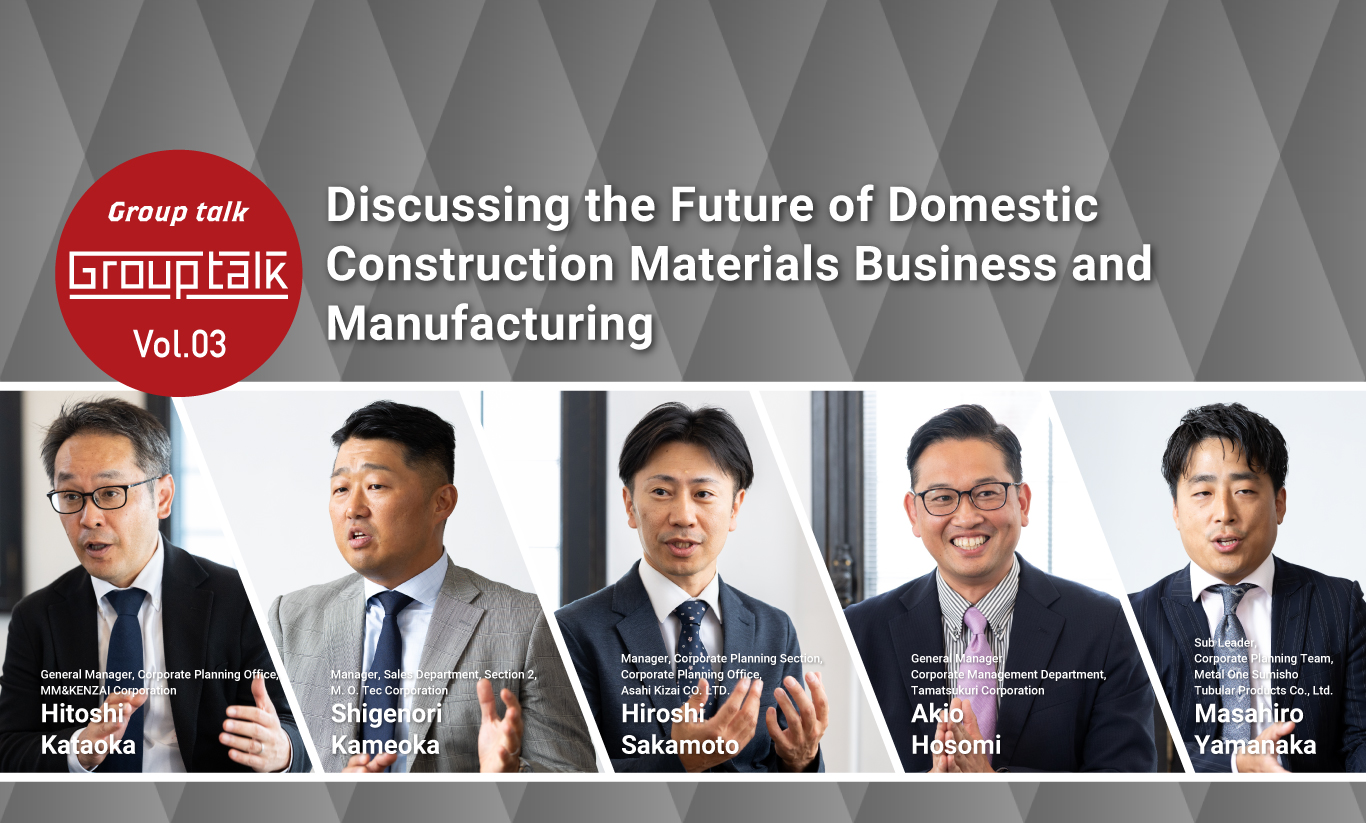
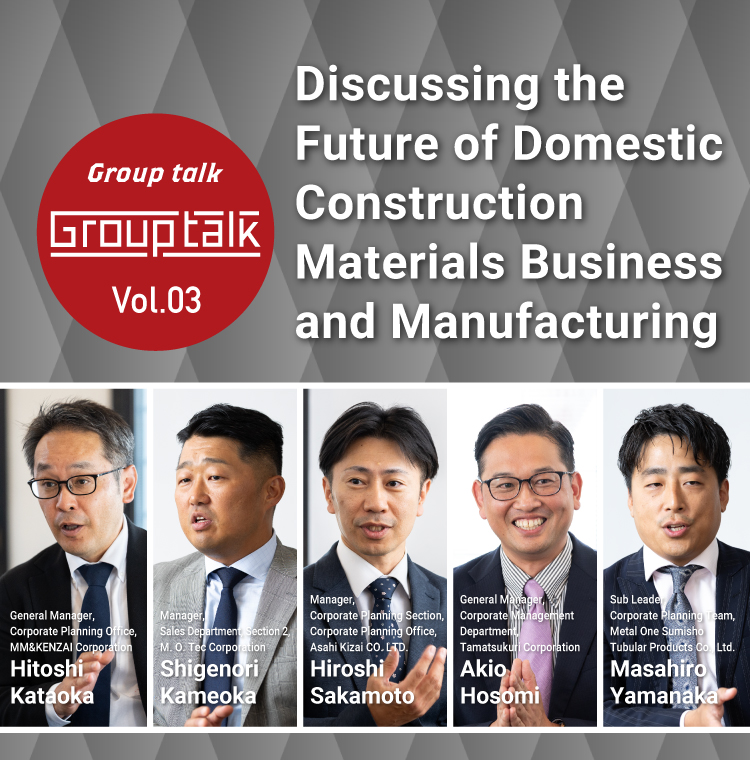
Vol.03 Discussing the Future of Domestic Construction Materials Business and Manufacturing Vol.03 Discussing the Future of Domestic Construction Materials Business and Manufacturing

A roundtable discussion was held on the construction materials business, which accounts for half of domestic steel demand, and on the future of manufacturing, bringing together key figures from related Metal One Group companies. The discussion was driven by members involved in drafting each company’s medium-term management plan, leading to a lively and engaging exchange.

Uniting the Strengths
of the Metal One Group
to Create New Value

To begin, please tell us about your company’s profile and its position in the industry.

Hitoshi Kataoka speaking.

Kataoka

MM&KENZAI Corporation was established through the integration of the Metal One Group and the Mitsui & Co. Group’s construction steel business division and steel making raw material business division, and this year marks its 11th anniversary. We handle sales of construction steel materials and scrap both domestically and internationally, as well as steel frame construction. While we are among the industry’s largest companies, we always approach our business with the spirit of a challenger. We also conduct ongoing business with each of the companies participating today, and I would like to take this opportunity to express my sincere gratitude for their continued support.
Hitoshi Kataoka speeking.

Sakamoto

Asahi Kizai CO. LTD. was established as a group company of TAKENAKA CORPORATION, later receiving capital participation from Mitsubishi Corporation and Metal One Group, and this year marks its 78th anniversary. Our business focuses on the rental and leasing of a wide range of temporary construction materials used at construction sites, as well as deck construction and related work. Leveraging the expertise gained at construction sites, including those of TAKENAKA CORPORATION, we have earned recognition for our technical capabilities and reliability in meeting on-site needs.

Hosomi

Tamatsukuri Corporation was founded in 1946, beginning with the sale of steel materials and non-ferrous metals. It became a Metal One Group company in 2005 and was renamed to its current name in 2007. Today, as a primary processor mainly handling gas and laser cutting of steel plates, we operate a business model centered on retail sales, delivering products nationwide with short lead times, small lots, and a wide variety.

Yamanaka

Metal One Sumisho Tubular Products Co., Ltd. was established in 2019 through the integration of Sumitomo Corporation and Metal One Group’s domestic steel pipe businesses. We serve a broad range of sectors, including construction, plants, industrial machinery, and automobiles, with operations at 42 locations nationwide. With industry-leading scale, our strength lies in combining the functions of a primary distributor with those of retail sales.

Kameoka

M. O. Tec Corporation was established in 1953, and this year marks its 73rd anniversary. With 21 sales offices and 17 factories across Japan, we handle everything from leasing and sales to the construction of heavy temporary construction materials indispensable to construction sites, such as H-beams and steel sheet piles. In recent years, construction has accounted for a higher proportion of our business, and we have been increasingly involved in projects in a subcontractor-like role.

How do you view the current state of the domestic market and its challenges?

Kameoka

Overall construction demand in Japan is on a downward trend, but large-scale redevelopment continues in the Tokyo metropolitan area, and special demand, such as for data centers, is keeping us busy in Kyushu and Hokkaido. However, it is uncertain how long this will last. In the Tokyo metropolitan area, although there are orders, construction sometimes does not start promptly due to labor shortages and other factors. In addition, procurement prices for temporary construction materials have risen in recent years, making competition based solely on leasing increasingly difficult. As a result, the importance of securing construction orders has grown, and differentiation through labor-saving measures and improved safety in construction will be the key to survival going forward.

Kataoka

One of the most significant impacts was the “2024 problem” in the construction industry. Amid labor shortages, the imposition of overtime restrictions accelerated delays in construction schedules and more selective order-taking. As Mr. Kameoka also mentioned, projects exist but are being postponed, creating a “delay in latent demand.” This has led to a greater-than-expected decline in domestic demand for construction steel materials and scrap, which I regard as a structural issue.
Our company is broadly involved in the supply chain from raw materials to finished products, but our current functions are heavily weighted toward trading. The challenges we face are to establish revenue pillars outside of trading and to play a role in addressing social issues where labor shortages have become a bottleneck.
Shigenori Kameoka speeking.

Sakamoto

From the perspective of the temporary construction materials leasing business, there are indeed fewer projects at present. The aging of workers and shortage of human resources are advancing, and the same challenges are evident at our management centers where we store and maintain temporary construction materials. For this reason, we believe mechanization and labor savings through digital transformation are urgent priorities. Although the construction industry has long been said to lag in digitalization, considerable progress has been made recently, and we are also focusing on digitalization within our company.
Shigenori Kameoka speeking.

Yamanaka

Our company specializes in the steel pipe business, but overall demand is still on a downward trend. In particular, shortages of workers and stagnation of projects are striking in the civil engineering and construction sectors. While we hold a leading position in the industry overall, this is not necessarily the case when looking at individual products and sectors. Under our medium-term management plan, which aims to be No. 1 in each area, we are focusing on consulting-based sales that include proposals for packages covering secondary processing and responding to customers seeking outsourcing of procurement functions.

Hosomi

Our company engages in primary processing of steel plates for industrial machinery, so we are somewhat removed from the construction industry, but I hope our perspective will be of reference. In recent years, domestic demand for cut steel plates has continued to decline, and the competitive environment has become even more severe. Even under these conditions, we are further strengthening our customer-focused sales approach to stay close to customers and capture their needs. In addition, we are utilizing our proprietary order information sharing system, “User Page Plus,” to deepen collaboration with business partners while working to enhance added value and customer satisfaction.

Listening to On-Site Voices
to Formulate
“Our Own”
Medium-Term Management Plan​

Based on recognition of industry challenges,
what kind of medium-term management plan was formulated?

Akio Hosomi speeking.

Hosomi

Our medium-term management plan covers the three-year period from fiscal 2025 to fiscal 2027. In order to further strengthen our sense of unity with on-site operations previously, this plan was formulated with directors, branch managers, and corporate department general managers serving as the persons responsible for each initiative, so that the entire company could move forward as one. In July 2025, we convened all employees for a presentation of the plan, where each responsible officer directly addressed them. This deepened understanding and penetration on-site, and we felt heightened awareness and enthusiasm toward the plan, with even proactive questions being raised regarding each initiative.
Akio Hosomi speeking.

Sakamoto

Our “2025–2027 medium-term management plan,” launched in April this year, looks ahead to our 80th anniversary in 2027 and the milestone of 2030. We surveyed all managers about their “aspirations for 2030” and utilized the results as the basis for identifying priority initiatives. Our slogan is “Toward a Professional Group that Supports Creation.” Temporary construction materials may leave no visible form, but they are indispensable to construction sites. We aim to be a company that contributes to worksites not only through the provision of materials and construction, but also by leveraging specialized knowledge and skills. Although it was challenging to consolidate opinions when formulating the plan, by intentionally setting ambitious goals for our desired vision of 2030, we are encouraging growth across the entire company.

Kataoka

Our company launched a new medium-term management plan this fiscal year. What we kept in mind when formulating it was to make it a plan that each employee could perceive as “their own.” Rather than a plan imposed unilaterally by the company, we sought to ensure it would be embraced as “our goal.” Our slogan is “Establishing a Growth Trajectory.” Built on the two pillars of growth strategy and foundation reinforcement, the plan seeks to construct a “next-generation supply chain” by strengthening core businesses, expanding business domains through the use of M&A, and taking on next-generation businesses with a long-term perspective.

Yamanaka

Our second medium-term management plan, launched in 2024, has the slogan “Aiming for No.1 in Each Field.” We seek further growth by not only leveraging overall strength but also becoming No.1 in individual sectors. We have set KPIs (key performance indicators) for each sales division to cascade down to the front lines, and have launched a portal site for the plan to visualize progress. We emphasize maximizing long-term value rather than focusing excessively on short-term profits, but we recognize that instilling this mindset remains a challenge going forward.

Kameoka

As I work in sales, I was only indirectly involved in drafting the plan, but the new medium-term management plan launched this year rests on three pillars: “higher revenue,” “green transformation,” and “digital transformation.” For “higher revenue,” against the backdrop of labor shortages, we aim to further strengthen “the earning power of each individual.” Our goal is to become a company of choice by expanding into adjacent business areas and adding value to construction methods and materials. For “green transformation,” we are promoting the use of green steel, biofuels, and low-carbon cement. For “digital transformation,” we are advancing proprietary development of a system called BIM/CIM, which combines three-dimensional “point cloud data” that instantly captures terrain and buildings. Personally, I believe it is important to strengthen the construction division and evolve it into a subcontractor-like role in order to address industry challenges such as labor shortages.

The Key to Group Collaboration
Is Metal One’s Leadership

What are your thoughts on collaboration within the Metal One Group?

Kataoka

Listening to everyone, I feel that the challenges faced by each company are quite common. Since each company has its own solutions, collaboration should allow us to save both time and cost. However, I believe a “small start” is essential for advancing collaboration. Rather than putting forward grand concepts, it is important to begin with small cases and move quickly. For that reason, I would like Metal One to demonstrate leadership as the flag bearer.

Hosomi

This roundtable discussion has been a very valuable opportunity, providing many insights and stimulation that I would not normally gain in daily work. I had thought that the construction industry and the industrial machinery industry were quite different and not closely related, but in fact there are many commonalities and numerous initiatives from through we can learn from each other. I believe that through such exchanges, natural connections and synergies will emerge. Since Metal One is in a position to oversee the Group as a whole, I believe it can play a unique role. It would be greatly appreciated if roundtables like this were organized and held on a regular basis, serving as a connector between key persons across Group companies.

Sakamoto

Opportunities to learn what people in corporate planning at other companies are thinking are rare, so today’s session was extremely valuable. However, it would be even better if such forums could be held not only for us but also for sales, administration, and on-site staff. For example, I feel that if there were mechanisms for more casual Group collaboration—such as small-group talks on specific themes or information exchanges at the on-site level—it could be applied even more directly to practical operations.
Masahiro Yamanaka speeking.

Yamanaka

From the same standpoint of corporate planning, I felt today was very instructive, as it allowed me to compare notes with everyone. Half of our company’s shareholders are Sumitomo Corporation, while MM&KENZAI Corporation also has MITSUI & CO., LTD., involvement. The Metal One Group encompasses a diverse mix of cultures, each with its own accumulated know-how. To leverage this “accumulation of knowledge,” I would like Metal One to take the lead in creating mechanisms for generating new value. Even in sales, by sharing various kinds of information, unexpected synergies could emerge.
Masahiro Yamanaka speeking.

Kameoka

We regularly collaborate with MM&KENZAI and Asahi Kizai, but I believe there are also many opportunities to work with other Metal One Group companies. For example, if we could collaborate in areas such as distribution, human resources, and digital transformation, issues common to all companies, it would certainly be beneficial, but in reality, we are often too busy with our own work to advance such efforts deeply. Even when good ideas exist, opportunities can be lost while we are still deliberating, so I believe it is important to respond with speed.

Lastly, please share your expectations of Metal One and any messages for all Group employees.

Yamanaka

This has been a valuable opportunity to reflect on the role our company should play within the Metal One Group. We aim for collaboration that leads not merely to information sharing, but to “value creation.” For this reason, it would be greatly appreciated if Metal One could serve as a “connector,” linking different perspectives, such as on-site and management, or sales and planning.
Shigenori Kameoka speeking.

Kameoka

From my position close to on-site operations, I feel that speed and flexibility are of utmost importance. In collaboration within the Group as well, I believe it is important not to be bound by formality, but to start by “giving it a try.” By strengthening collaboration with Metal One, I would like to see ideas brought beyond the conceptual stage into concrete form. I hope today’s roundtable discussion will serve as such a catalyst.
Shigenori Kameoka speeking.

Sakamoto

Working in the niche field of temporary construction materials, one’s perspective can easily become narrow, but by learning about the initiatives of other companies through opportunities like today, I have gained new viewpoints. I believe that collaboration as a Group begins with “getting to know one another.” By sharing each other’s strengths and challenges, let us build mechanisms that foster natural collaboration.

Hosomi

The insights I gained from this roundtable discussion also provided an opportunity to reassess our company’s strengths and challenges. Going forward, I hope that opportunities will continue to be provided across the Metal One Group for candid exchanges of views that cross job types and industries, in order to advance reforms originating from the front lines. For my part, I intend to link the perspectives gained through such forums to the growth of my company and contribute to enhancing the value of the Group as a whole.

Kataoka

Through today’s roundtable discussion, I once again realized the breadth of knowledge and experience within the Group. By utilizing these resources, it is possible to find optimal solutions to a wide range of challenges. However, unless “Group collaboration” is raised as a priority, it will ultimately remain nothing more than an empty vision. As mentioned earlier, even small things are fine—what matters is taking on challenges together. I believe it is acceptable to fail. The only one that can take on the role of flag bearer is Metal One, which has the ability to see the Group as a whole. I have great expectations for that leadership.

Thank you very much for your time today.

Five speakers are smiling warmly and chatting pleasantly.

SPEAKER

  • Hitoshi Kataoka

    Hitoshi Kataoka

    MM&KENZAI Corporation
    General Manager, Planning Departments

  • Shigenori Kameoka

    Shigenori Kameoka

    M. O. Tec Corporation
    Manager, Sales Department Section 2

  • Hiroshi Sakamoto

    Hiroshi Sakamoto

    Asahi Kizai CO. LTD.
    Manager, Corporate Planning Section, Corporate Planning Office

  • Akio Hosomi

    Akio Hosomi

    Tamatsukuri Corporation
    General Manager, Corporate Management Department

  • Masahiro Yamanaka

    Masahiro Yamanaka

    Metal One Sumisho Tubular Products Co., Ltd. Sub-leader, Corporate Planning Team

(As of September 2025)